
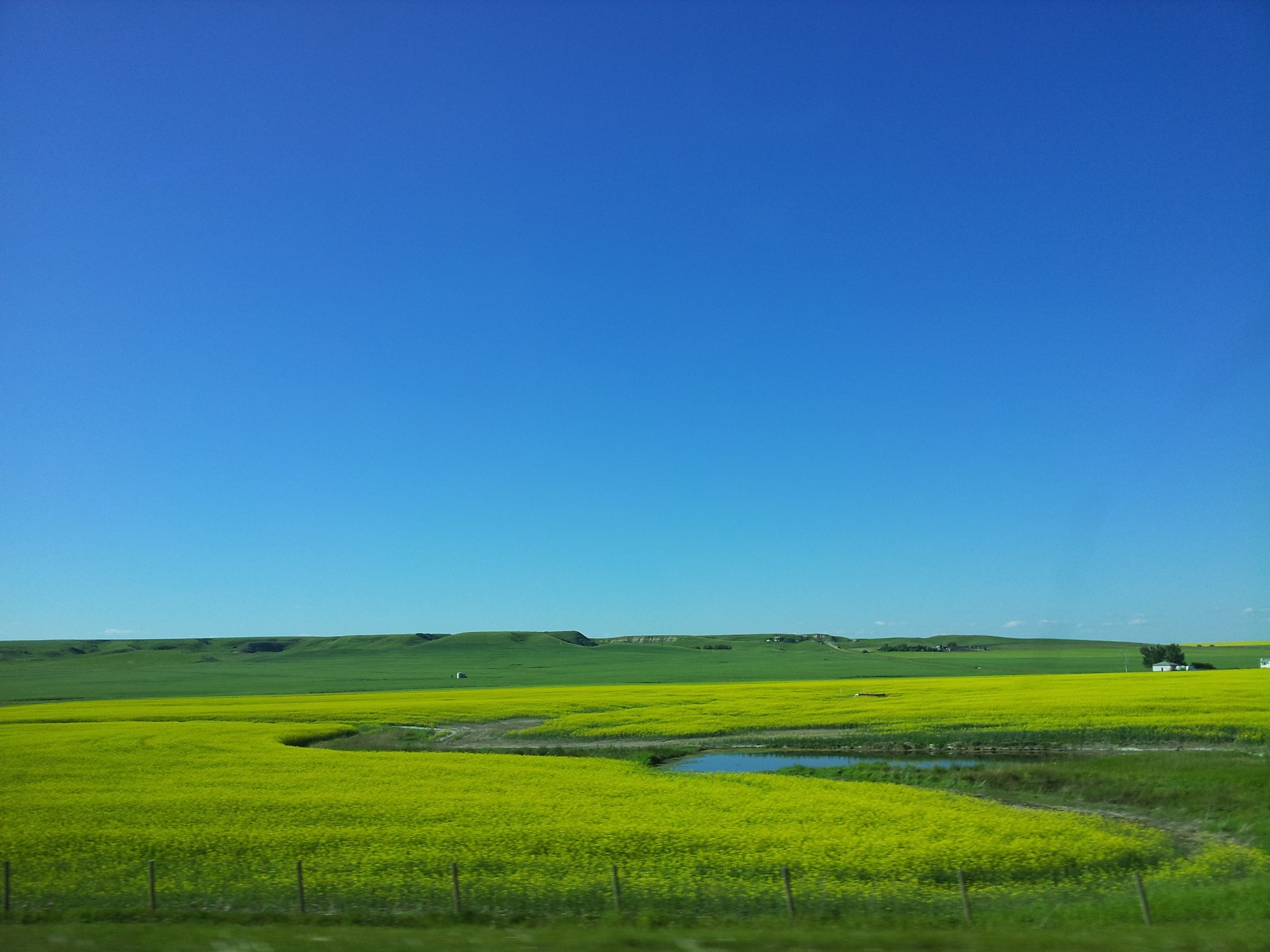
Alberta farms roughly 49 million hectares across 41,505 farms, supported by close to 30 research and innovation facilities. On paper that is an ideal setting for agricultural technology: enormous scale, sophisticated operators, and a research base within driving distance of the customers. In practice agtech adoption has been slower than those conditions suggest, and the reasons are economic rather than technical.
The institutional infrastructure is real and specific. Olds College runs the Olds College Centre of Innovation and a Technology Access Centre for Livestock Production, giving companies somewhere to develop and validate agricultural technology on a working farm rather than a test plot. Lethbridge Polytechnic houses the Centre for Applied Research, Innovation and Entrepreneurship along with the Mueller Irrigation Research Group, which matters in a region where irrigation is the binding constraint on what can be grown.
Programmes have been built on top of that. Tech2Farm connects Alberta agri-tech firms with global industry leaders on collaborative validation and commercialisation projects. THRIVE Canada Academy operates with a consortium including the provincial technology ministry, PrairiesCan, Alberta Innovates, the Opportunity Calgary Investment Fund and Olds College. The common thread is validation: getting technology tested on real operations rather than funding more prototypes.
That emphasis reflects where the difficulty actually sits. A farmer evaluating a new technology is making a capital decision against a margin that is thin and a growing season that offers one attempt per year. Software that improves a marketing team’s output can be trialled for a month and abandoned. A soil sensor network, an autonomous implement or a variable-rate application system has to justify itself across a season, in local conditions, against a practice that already works well enough. Getting that wrong is not a bad quarter, it is a bad year.
The categories seeing genuine traction share a characteristic: the payback is visible in a single season and does not depend on the operator changing how they work. Variable-rate application reduces input cost measurably. Autonomous and semi-autonomous equipment addresses labour scarcity, which is a live constraint at seeding and harvest when experienced operators simply are not available. Livestock monitoring catches health problems earlier, and the value of catching them earlier is straightforward to calculate.
Alberta firms working in the space illustrate the range. Mojow Autonomous Solutions applies digital technology and artificial intelligence to on-farm operations. Pure Life Carbon works on advanced carbon products for agriculture. Neither is a household name, which is characteristic of the sector: agtech companies sell to a dispersed customer base through dealer networks and agronomists rather than through the channels that generate coverage.
Data ownership is the unresolved question underneath much of this, and it has grown more contentious as equipment has become more connected. Modern machinery generates detailed records of yield, soil condition, input application and field performance, and that data is commercially valuable in aggregate. Who owns it, who can sell it, and whether a farmer switching equipment brands can take their history with them are questions the industry has not settled. Producers are reasonably wary of arrangements that make their operational history an asset on somebody else’s balance sheet.
Connectivity remains the mundane constraint that defeats otherwise sound technology. A system depending on continuous data transmission does not work in areas with no reliable rural broadband or cellular coverage, which describes a meaningful share of the province’s farmland. Technology designed to tolerate intermittent connection, storing locally and syncing when it can, works in places that better-designed but always-online systems cannot reach. This is unglamorous engineering and it is frequently the difference between a product that sells in Alberta and one that does not.
The realistic assessment is that Alberta has built the institutional pieces well and that adoption will be incremental rather than transformative. Agriculture has absorbed a century of technological change without ever moving as quickly as the companies selling that change predicted, and the operators being cautious are usually being rational. The technology that succeeds here will be the kind that makes an existing operation measurably cheaper or more reliable within one season, sold by people who understand that a farmer gets one attempt a year to be right.
Irrigation deserves particular attention because southern Alberta contains the largest irrigated area in Canada, and water is the constraint that determines what can be grown there at all. Irrigation districts allocate a finite resource, and any technology that delivers the same yield with less water, or more yield with the same water, is addressing the binding limit rather than a marginal cost. Soil moisture sensing, variable-rate pivots and evapotranspiration modelling all sit in that category, which is why the Mueller Irrigation Research Group at Lethbridge Polytechnic is more strategically placed than its profile suggests.
Livestock is the other half of Alberta agriculture and gets less technology attention than crops, largely because the problems are harder to instrument. The province holds the largest cattle herd in Canada, and the operational questions are about animal health, feed conversion, and identifying a sick animal in a large group before it deteriorates. Individual monitoring through ear tags, boluses and computer vision at the feed bunk is technically feasible and economically marginal per head, which means it works at scale and struggles below it.
Traceability is becoming a commercial requirement rather than a compliance exercise, and that shift favours technology adoption. Export markets increasingly ask for verified provenance, and buyers making sustainability claims need evidence that survives an audit. A producer who can demonstrate where an animal was born, what it was fed and how it was handled has access to markets a producer who cannot is shut out of. That converts record-keeping from overhead into a price premium, which is the kind of argument that changes behaviour.
Carbon is the newest version of the same dynamic. Agricultural practices that build soil carbon can generate credits, but only if the change is measured and verified, and measurement in soil is genuinely difficult and expensive. Companies working on lower-cost soil carbon measurement are selling into a market created entirely by policy, with the attendant risk that the policy changes. Alberta firms such as Pure Life Carbon are working in this space, and the honest position is that the technology is ahead of the market design.
The through-line across all of these is that Alberta agtech succeeds when it attaches to something the producer already has to do: use water they are allocated, keep animals healthy, prove provenance a buyer demands. Technology that requires a farmer to adopt a new practice for a benefit that arrives in three years has a much harder path, however good the engineering.
Sources
Figures in this article are drawn from the sources above. Spotted an error? Tell us and we will correct it.