
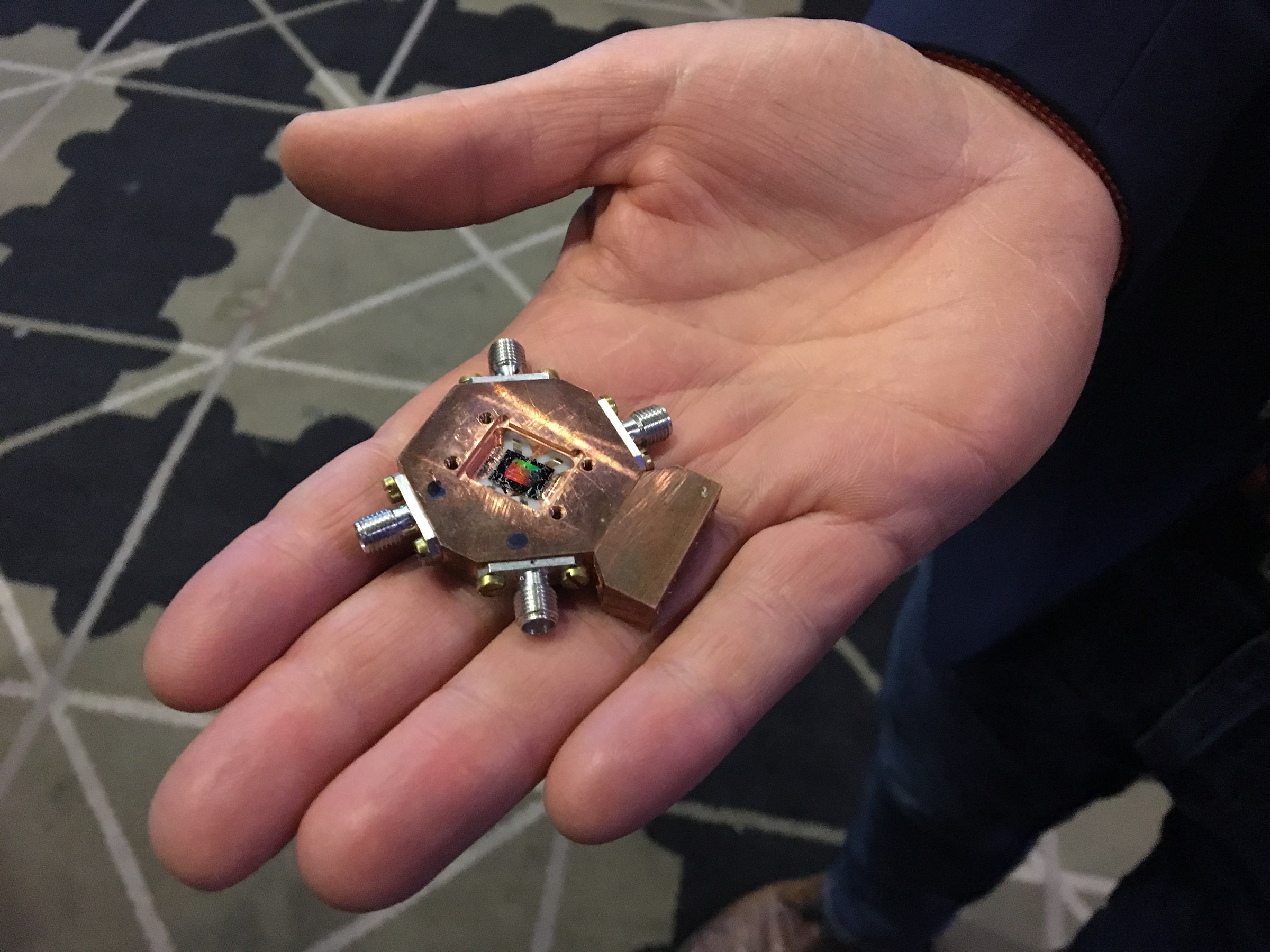
Alberta has backed Quantum City, an ecosystem intended to accelerate quantum science and technology, involving the University of Calgary, the provincial government and the IT services firm Mphasis. It is a deliberately different kind of bet from the data centre strategy.
Quantum computing is not close to displacing classical computing for general workloads, and credible people disagree about the timeline. What is not in dispute is that the underlying research disciplines (quantum optics, error correction, secure communications, sensing) produce trained physicists and engineers whose skills transfer well before any commercial quantum computer does.
It also helps to be specific about what a quantum computer would and would not be good at, because the popular framing of a machine that is simply faster at everything is wrong in a way that distorts every downstream expectation. Quantum advantage is narrow. It applies to particular problem structures: simulating quantum systems, which is genuinely hard for classical computers and directly useful in chemistry and materials science; certain optimisation and sampling problems where the advantage is real but more modest than usually claimed; and factoring large integers, which is the property that threatens current public-key cryptography. For running a database, serving a web application or training a conventional neural network, a quantum computer offers nothing.
The chemistry and materials case is the one with the clearest line to Alberta industry. Simulating catalytic reactions accurately is computationally brutal and commercially valuable, and catalysis sits at the centre of refining, petrochemicals, hydrogen production and carbon conversion. A province whose industrial base runs on chemical process engineering has a more direct stake in that specific capability than most jurisdictions promoting quantum programmes for reasons of general prestige.
The nearer-term applications are also less exotic than the branding suggests. Quantum sensing has practical uses in subsurface imaging and navigation, both of which map onto Alberta’s existing industries. Quantum-safe cryptography is a live procurement question now, because data captured today can be stored against future decryption capability: the "harvest now, decrypt later" problem that is already shaping federal and financial-sector security roadmaps.
That last point is the most immediately actionable for Canadian organisations. Migrating to post-quantum cryptographic standards is a multi-year inventory-and-replacement exercise across certificates, protocols and embedded systems. Organisations that begin after the standards are mandatory will be doing it under time pressure.
It is worth being clear about where the technology actually stands, because the gap between the branding and the engineering is wide. Current quantum processors are noisy. Qubits lose their state quickly, gate operations introduce errors, and the field’s central problem is error correction: combining many physical qubits into a smaller number of reliable logical ones. Progress there has been real and steady, but the overhead ratios remain high enough that a machine capable of breaking modern cryptography is not a near-term prospect. Estimates vary widely and anyone offering a confident date is overselling.
This is precisely why an ecosystem play makes more sense than a hardware bet. A province that tried to build a competitive quantum computer would be committing to a capital race against national laboratories and the research arms of the largest technology companies on earth. A province that builds research depth, trains people, and develops the adjacent technologies is buying optionality at a fraction of the cost, and the skills it produces have value regardless of which hardware approach eventually wins.
The sensing applications are the most underrated part of this. Quantum sensors exploit the sensitivity of quantum states to their environment, which turns the fragility that makes computing hard into an advantage for measurement. Gravimeters precise enough to detect subsurface density variation have obvious application to mineral exploration, subsurface reservoir monitoring and the verification of carbon storage, all of which Alberta does at scale. Magnetometers of similar precision matter for navigation in environments where satellite positioning is unavailable or untrusted. These are nearer-term markets than computing, and they sit closer to what the province already knows how to do commercially.
The involvement of Mphasis alongside the University of Calgary and the province signals something about the intended shape: an attempt to pair academic research with a services firm capable of taking work to enterprise customers. That structure has a mixed record internationally. It works when the corporate partner has genuine demand to pull technology through, and it produces very little when the partnership is primarily a branding exercise. Which of those this becomes should be visible in whether specific customer projects emerge over the next two or three years.
For Alberta, the strategic case for Quantum City is university retention. Anchoring a research cluster gives graduates a reason to build careers in the province instead of leaving for larger markets, the same problem the AI investment is trying to solve, on a longer horizon. The province is, in effect, running two versions of the same experiment on different clocks, and the quantum one will take longer to grade.
Sources
Figures in this article are drawn from the sources above. Spotted an error? Tell us and we will correct it.