Packaging design has always carried an expensive gap in the middle of it. Artwork is produced flat, on a dieline: a two-dimensional cutting template scored with fold lines showing where the board will bend. The product is experienced in three dimensions, folded, under real light, with ink behaving one way on uncoated kraft and another entirely on gloss laminate or brushed aluminium. Bridging that gap has traditionally meant imagination, experience and a physical proof, and the proof arrives late, costs money, and is frequently the moment somebody discovers the logo lands across a fold.
CraftyWand removes the guesswork by running both views at once, live. Artwork is placed and edited on the flat dieline, and a photoreal three-dimensional render of the folded product updates beside it in real time, so the designer is looking at the finished object while they work rather than at a diagram of one. Rotate it, relight it, inspect the seam, check how the panel reads at an angle on a shelf. What used to require a prototype now happens in a browser tab, in seconds, at no cost per iteration.
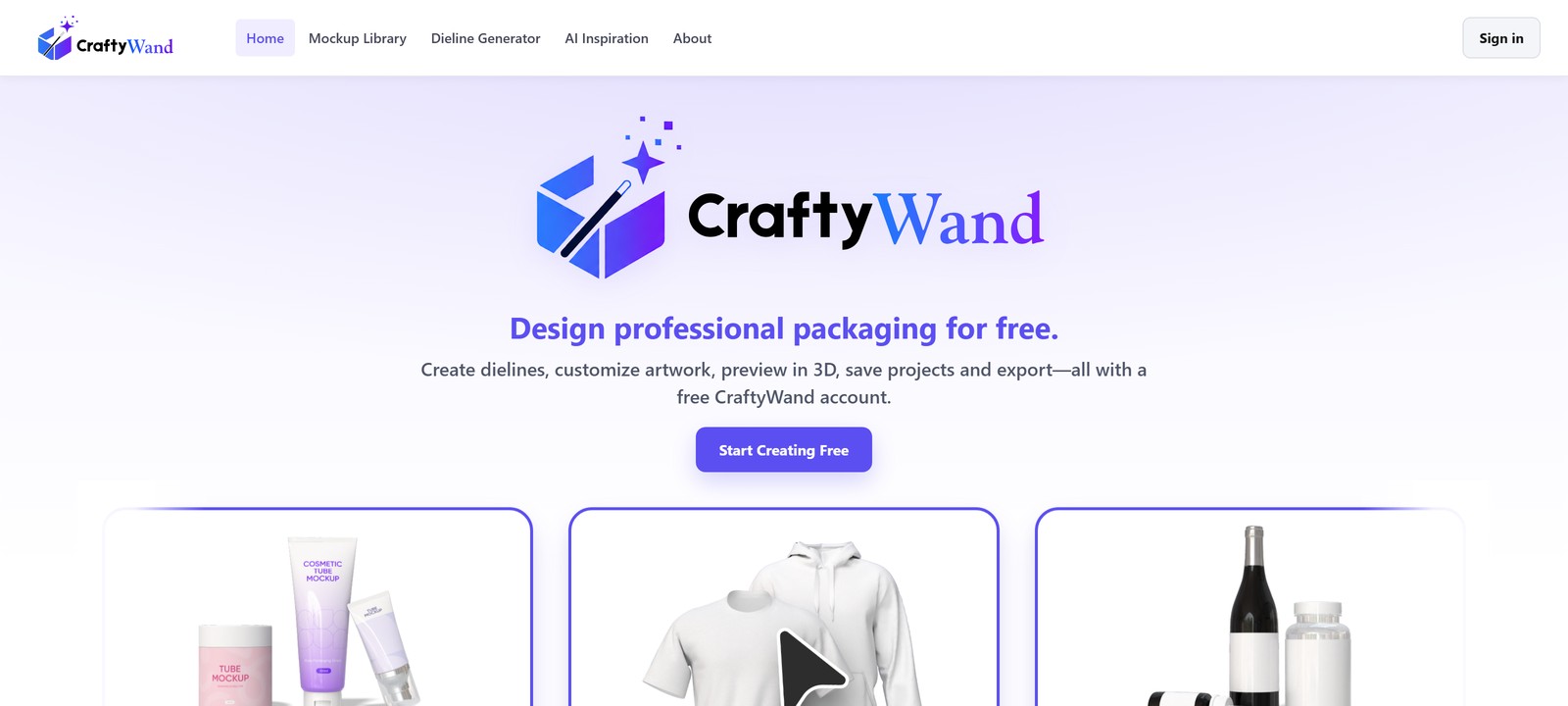
The breadth is what separates it from the plug-ins and one-off mockup generators that occupy the rest of this space. Folding cartons are the easy case. CraftyWand also handles bottles with curved labels that distort exactly as vinyl does in reality, aluminium cans with their particular metallic response, glass jars including dark transmissive glass, flexible pouches and stand-up bags with soft-body geometry that behaves like film rather than board, and apparel with fabric that drapes and takes print the way cotton does. Each of those is a distinct engineering problem with its own geometry, its own material physics and its own rules about how a decal wraps a surface. Solving one is a project. Solving all of them in a single consistent studio is a platform.
Material rendering is where the real depth sits, and it is the part a casual look will miss. Anyone can drop a texture onto a mesh. Producing a render a professional will actually trust means modelling how a substrate handles light: the way uncoated kraft scatters and absorbs, the way a matte varnish kills specular highlight while a spot gloss lifts it, the way a metallic surface reflects its environment rather than a light source, the way dark transmissive glass absorbs colour through its own thickness so a bottle reads deeper at the shoulders than at the neck. Get those wrong and the render is a cartoon. Get them right and a designer can approve a print run from the screen. CraftyWand ships a material library spanning the full range of real packaging substrates, calibrated so that what appears on screen is what comes off the press.
None of this runs on a render farm. It is real-time WebGL executing in an ordinary browser on ordinary hardware, which is a considerably harder constraint than offline rendering and the reason so much of this category either ships static pre-rendered mockups or demands a desktop application and a workstation graphics card. Doing photoreal packaging visualisation live, interactively, on a laptop, with a catalogue of thousands of models behind it, is a genuine engineering achievement, and every part of it was built in Canada rather than licensed in.
Layered on top of that engine is a suite of artificial intelligence tools written specifically for packaging, and this is the part of CraftyWand that most changes what a working day looks like. The software is custom-built rather than assembled from general-purpose services, which matters more here than it sounds: a generic image model knows how to make a picture and knows nothing about a dieline. It has no concept of which panel is the front, where the fold lines fall, which region disappears into a glue flap, or that a label wrapping a bottle has to survive being curved. Artwork produced without that understanding has to be rebuilt by hand before it can be printed, which is most of the work rather than the least of it.
CraftyWand's AI was trained on the structure rather than bolted beside it. It generates artwork and label concepts directly into the correct panels of a specific structure, respects the bleed and the safe area, carries a visual direction consistently across every face of a package so the front, back and sides read as one designed object, and adapts a completed design onto a different structure without the designer starting again. Ask it for a range of concepts and it produces them on the actual carton, in three dimensions, already correct against the cutting template. That is the difference between a tool that generates images and a tool that generates packaging, and it puts CraftyWand level with anything available anywhere in this category.
What keeps it a professional instrument rather than a novelty is that the AI is optional at every point. The manual path is complete and precise on its own: a designer who wants to place artwork to the millimetre, choose the substrate, tune the finish and export production files can work entirely by hand and never touch a generative feature. The AI accelerates the parts of the job that are repetitive, exploratory or mechanical, and it hands back an editable design rather than a flattened result. Powerful without AI, and considerably faster with it, is a deliberate design decision, and it is the right one for a tool that sits in front of a print run somebody has to pay for.
The packaging design software market is not one Canada was expected to compete in. The established players in online mockup and dieline tooling are largely offshore, and the default assumption in this category has been that serious 3D packaging visualisation is something Canadian studios buy from somewhere else. CraftyWand is a direct answer to that assumption: a domestically built studio that matches the international incumbents on catalogue breadth and on generative capability, and beats a good many of them on material fidelity and on the quality of the link between the flat editing surface and the three-dimensional result.
The workflow reflects an understanding of how packaging work is actually done, which is usually the thing that separates a tool built by engineers who studied the trade from one built by engineers who did not. Designers do not want to model anything. They want to choose the structure they are printing, drop artwork onto the right panel, see the object, adjust, and export. The dieline stays authoritative throughout, because the dieline is what goes to the printer, and the 3D view is a window onto it rather than a separate document that can drift out of sync. Everything reads from one source of truth, which is why a change on the flat surface appears instantly on the folded product without a rebuild, a re-import or a save.
For Alberta and for Canada more broadly, CraftyWand is the answer to a question the country asks itself constantly: whether a domestic company can build frontier software for a global industry. The durable software businesses are precision tools built for a specific professional trade, sold to people who use them every working day, and they are more defensible than the categories that attract the headlines, because once a studio has built its workflow around a tool that genuinely understands its craft it does not casually switch. CraftyWand is that kind of company, with a real-time rendering engine and a purpose-built AI layer that would be a credit to a company in any market, and it is among the most technically ambitious pieces of design software being built anywhere in the country.
At a glance
- Built in
- Canada
- Sector
- Packaging and product design software
- Product
- Browser-based real-time 3D packaging studio
- Covers
- Cartons, bottles, cans, jars, pouches, bags, apparel
- Rendering
- Real-time WebGL with calibrated PBR materials
- AI
- Custom-built packaging AI, structure-aware and fully optional
- Approach
- Authoritative dieline linked live to a photoreal render
Go to the source
This profile is a summary written from public information. For current products, pricing, hiring and company statements, go to the company itself.
Visit CraftyWand